A Determinant Model of Sustainable Tuberculosis Treatment Compliance Based on the Health Belief Model in Tuberculosis Patients in Surakarta, Central Java, Indonesia
DOI:
https://doi.org/10.26911/Abstract
Background: Tuberculosis (TB) is an infectious disease that remains a major global and national public health problem, with Indonesia ranking second worldwide after India. Treatment adherence is a key determinant of therapeutic success, yet it continues to be challenged by high dropout rates and drug resistance. This study aims to examine the Health Belief Model in relation to treatment adherence among tuberculosis patients in Surakarta.
Subjects and Method: This was a cross-sectional study conducted in Surakarta. A total of 400 tuberculosis patients were selected as the study sample. The dependent variable was treatment adherence. Independent variables included perceived susceptibility, perceived severity, perceived benefits, perceived barriers, cues to action, self-efficacy, and family support. Data were collected using a questionnaire and analyzed using path analysis.
Results: Treatment adherence increased with higher cues to action (b = 4.01; 95% CI = 0.80 to 7.22; p = 0.01), perceived susceptibility (b = 2.00; 95% CI = 0.46 to 3.53; p = 0.01), and perceived benefits (b= 3.05; 95% CI= 0.17 to 5.93; p = 0.01). In contrast, higher perceived barriers decreased treatment adherence (b= –2.70; 95% CI = –4.39 to –1.01; p = 0.001). Indirectly, cues to action increased family support (b= 2.10; 95% CI= 0.13 to 4.08; p = 0.010), and perceived barriers increased cues to action (b= 3.68; 95% CI= 1.13 to 6.23; p = 0.01). Perceived susceptibility decreased cues to action (b = –0.64; 95% CI= –1.25 to –0.03; p = 0.01) but increased perceived barriers (b = 4.85; 95% CI = 1.17 to 8.54; p= 0.01). Perceived severity increased perceived barriers (b = 1.75; 95% CI = 0.41 to 3.09; p = 0.01) and decreased family support (b = –0.83; 95% CI = –1.48 to –0.18; p = 0.01), while perceived benefits increased family support (b = 2.41; 95% CI = 0.32 to 4.50; p = 0.01).
Conclusion: Higher cues to action, perceived susceptibility, and perceived benefits, as well as lower perceived barriers, improve treatment adherence. Family support also plays an important mediating role in strengthening adherence among tuberculosis patients.
Keywords:
medication adherence, health belief model, cues to action, family support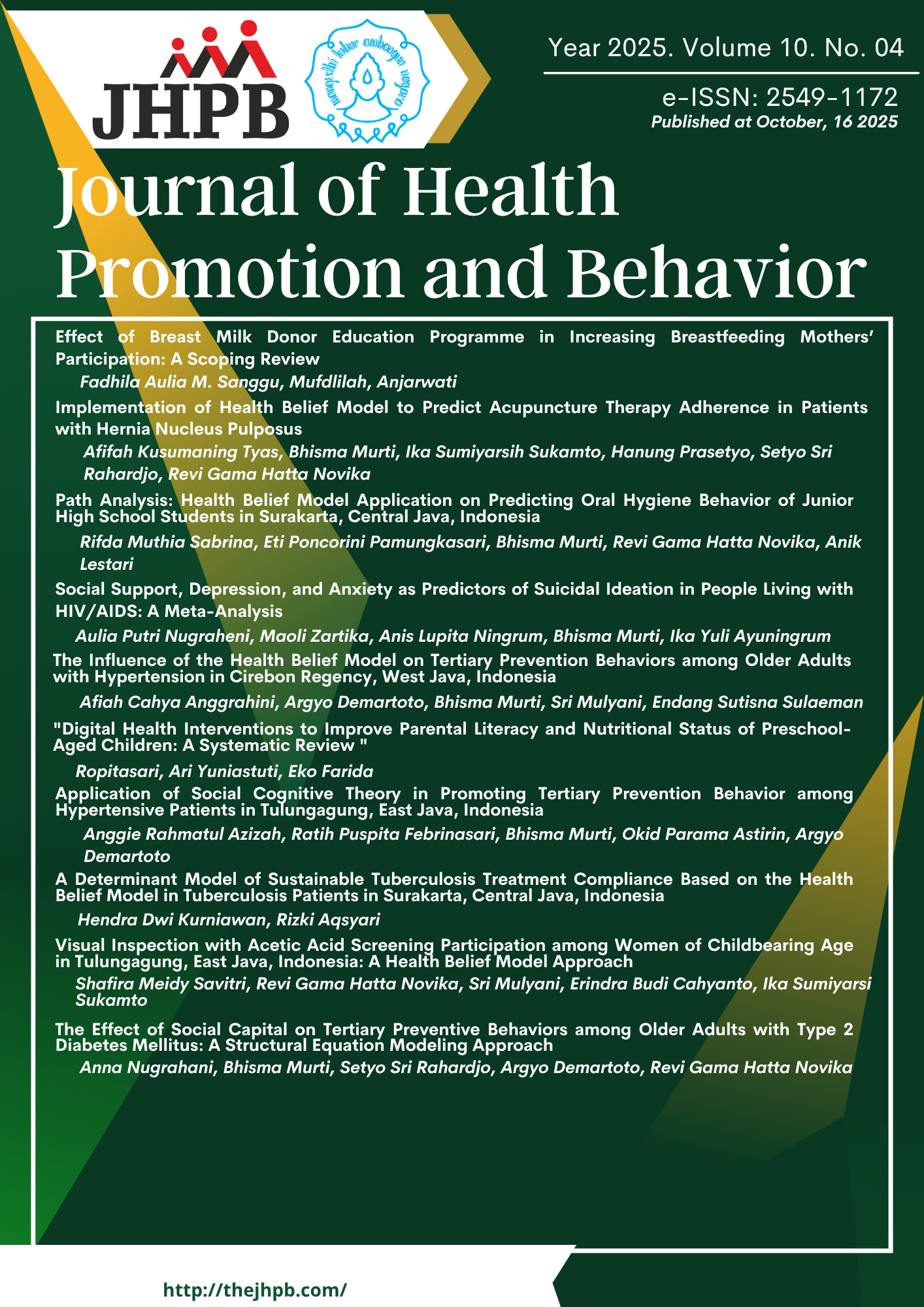
How to Cite
References
Alyafei A, Easton-Carr R. (2024). The health belief model of behavior change. StatPearls.
Efendi S, Sjattar EL, Syam Y. (2022). Health counseling supports medication adherence to regular pulmonary tuberculosis patients. Clin Epidemiol Glob Health. 15:101055. doi:10.1016/j.cegh.2022.101055.
Fauziyah TA, Putri GS. (2024). TB cases in Indonesia increase, Central Java one of the highest. Kompas.
Glanz K, Rimer BK, Viswanath K. (2015). Health behavior: theory, research, and practice. 5th ed. Jossey-Bass.
Khamis KM, Shahar HK, Manaf RA, Hamdan HM. (2022). Effectiveness of educational intervention of tuberculosis treatment adherence in Khartoum State: a study protocol for a randomized control trial. PLoS One. 17(11):e0277888. doi:10.1371/journal.pone.0277888.
Khoirunissa HA. (2021). Tuberculosis (TB) risk mapping in Surakarta City using spatial empirical Bayes. Indones J Appl Stat. 3(2):78–85. doi:10.13057/ijas.v3i2.41282.
Munro SA, Lewin SA, Smith HJ, Engel ME, Fretheim A, Volmink J. (2007). Patient adherence to tuberculosis treatment: a systematic review of qualitative research. PLoS Med. 4(7):e238. doi:10.1371/journal.pmed.0040238.
Nurmala I, Rahman F, Nugroho A, Erlyani N, Laily N, Anhar VY. (2018a). Promoting healthy behavior using the health belief model. Indian J Public Health Res Dev. 9(10):125–130.
Nurmala I, Hidayat M, Rahman F, Syahrul S. (2018b). Application of the health belief model on the compliance of TB patients in taking medication. Indian J Public Health Res Dev. 9(4):173–177. doi:10.5958/0976-5506.2018.00352.7.
Pagès-Puigdemont N, Mangues MA, Masip M, Gabriele G, Fernández-Maldonado L, Blancafort S, et al. (2016). Patients’ Perspective of Medication Adherence in Chronic Conditions: A Qualitative Study. Adv Ther. 33(10):1740–1754. https://doi.org/10.1007/s12325-016-0394-6.
Sartika D, Suarjana IN, Utami NM. (2020). The effectiveness of self-management education based on the health belief model on medication adherence of patients with type 2 diabetes mellitus. Bali Med J. 9(3):743–750.
Sazali MF, Rahim SS, Mohammad AH, Kadir F, Payus AO, Avoi R, Jeffree MS, et al. (2023). Improving tuberculosis medication adherence: the potential of integrating digital technology and health belief model. Tuberc Respir Dis. 86(2):82–93. doi:10.4046/trd.2022.0148.
Suprijandani S, Setiawan S, Pathurrahman P, Wardoyo S, Rahayyu AM. (2025). The behavior of TB patients in East Lombok through a health belief model approach. J Health Popul Nutr. 44(1):23. doi:10.1186/s41043-025-00528-y.
Wulandari D, Pratiwi NL, Sari M. (2020). Determinants of medication adherence among hypertensive patients. Kesmas. 15(2):85–92.
Yadav RK, Kaphle HP, Yadav DK, Marahatta SB, Shah NP, Baral S, Khatri E, et al. (2021). Health related quality of life and associated factors with medication adherence among tuberculosis patients in selected districts of Gandaki Province of Nepal. Clin Tuberc Other Mycobact Dis. 23:100235. doi:10.1016/j.jctube.2021.100235.
Zhou C, Chu J, Liu J, Tobe R, Gen H, Wang X, Zheng W, Xu L. (2012). Adherence to tuberculosis treatment among migrant pulmonary tuberculosis patients in Shandong, China: a quantitative survey study. PLoS One. 7(12):e52334. doi:10.1371/journal.pone.0052334.