Implementation of the Health Belief Model to Predict Acupuncture Therapy Adherence in Patients with Hernia Nucleus Pulposus
DOI:
https://doi.org/10.26911/thejhpb.2025.10.04.02Abstract
Background: Hernia Nucleus Pulposus is one of the causes of low back pain that can interfere with activity and quality of life. Acupuncture therapy is one of the effective non-pharmacological treatment alternatives in reducing pain due to Hernia Nucleus Pulposus. However, patient adherence to undergoing acupuncture therapy is still a challenge. This study aims to analyze the factors within the framework of the Health Belief Model that affect adherence to acupuncture therapy in patients with Hernia Nucleus Pulposus.
Subjects and Method: This study was a cross-sectional study conducted in Surakarta, from January to March 2025. A total of 200 patients were selected randomly. The dependent variable was adherence to acupuncture therapy in Hernia Nucleus Pulposus. Independent variables were perceived susceptibility, perceived severity, perceived benefits, perception of barriers, self-efficacy, and cues to action. The data were analyzed using Linear Regression.
Results: Adherence to acupuncture therapy patients with hernia nucleus pulposus increased with high perceived susceptibility (b=0.14; 95% CI= 0.01 to 0.27; p= 0.040), high perceived severity (b= 0.30; 95% CI= 0.02 to 0.59; p=0.038), high perceived benefits (b= 0.16; 95% CI= 0.01 to 0.31; p=0.042), high cues to action (b=0.19; 95% CI= 0.02 to 0.36; p= 0.032), high self-efficacy (b=0.19; 95% CI= 0.02 to 0.38; p= 0.022). Adherence to acupuncture therapy decreased with high perceived barrier (b= -0.10; 95% CI= -0.21 to -0.01; p= 0.046).
Conclusion: There was a positive relationship between perceived susceptibility, perceived severity, perceived benefits, cues to action, and self-efficacy on adherence to acupuncture therapy. Perceived barriers decrease adherence to acupuncture therapy in hernia nucleus pulposus.
Keywords:
health belief model, adherence, acupuncture therapy, hernia nucleus pulposus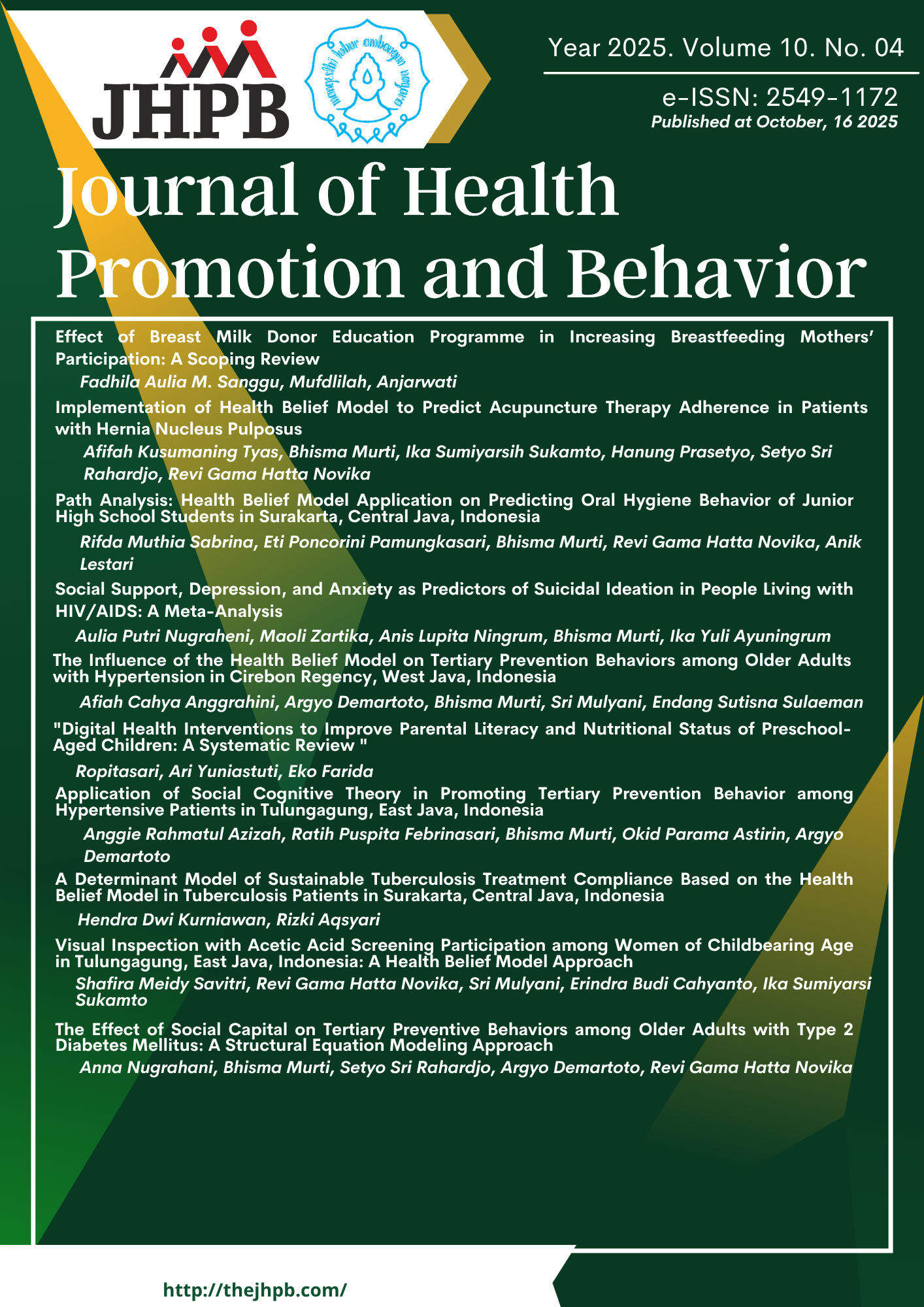
How to Cite
References
Abid M, Khan HU, Abid MH, Ijaz A, Ahmad M, Naeem MT, Raza H (2021). Association of occupational risk factors with the level of lumbar disc nucleus pulposus herniation. Pakistan J Med Health Sci. 2863-2864. https:-//doi.org/10.53350/pjmhs2115102863.
Alayat MSM, Alshehri MA, Shousha TM, et al (2019). The effectiveness of high intensity laser therapy in the mana-gement of spinal disorders: a syste-matic review and meta-analysis. J of back and Musculoskelet Rehabilita-tion. 32(6):869-884. doi:10.3233/-BMR-181341.
Bishop FL, Yardley L, Cooper C, Little P, Lewith G (2017). Predicting adhe-rence to acupuncture appointments for low back pain: a prospective observational study. BMC comple-ment. Altern med. 2017 Jan 3;17(1):5. doi: 10.1186/s12906-016-1499-9.
Chikaka T, Keller MM (2024). Low back pain treatment adherence barriers in Eswatini private physiotherapy pra-ctices: a pilot study. S Afr J Physio-ther. 80(1): a2077. https://doi.org/-10.4102/sajp.v80i1.2077.
Colloca L (2019). The placebo effect in pain therapies. Annu Rev pharmacol Toxicol. 6(59):191-211. doi: 10.11-46/annurev-pharmtox-010818-021-542.
Deneau D (2022). The New Frontiers in Pain Medicine: Current Advance-ments and future directions. Clin J Pain. 702-710.
Hincapie C A, Kroismayr D, Hofstetter L, Kurmann A, Cancelliere C, Raja RY, et al. (2025). Incidence of and risk factors for lumbar disc herniation with radiculopathy in adults: a systematic review. European Spine J. 34(1): 263–294. https://doi.org/10.1007/s00586-024-08528-8.
Howay SL, Sutarto, Larasati TA (2022). Identifikasi faktor risiko herniated nucleus pulposus. J Agromedicine UNILA. 1-5.
Huang Z, Liu S, Zhou J, Yao Q, Liu Z (2019). Efficacy and safety of acu-puncture for chronic discogenic scia-tica, a randomized controlled sham acupuncture trial. Pain Med. 20(11), 2303-2310.
Jin H, Lopez AM, Garza Romero F, Hoang R, Ramesh A, Bow HC (2025). A systematic review of treatment guide-lines for lumbar disc herniation. Neurospine, 22(2):38 9‑40 2. doi:10.-14245/ns.2550398.199
Liu Q, Zhang H, LinF, Chen L, Wang Z (2023). Acupuncture treatment for lumbar disc herniation with scoliosis. medicine, 1-5. http://dx.doi.org/10.-1097/MD.0000000 000036684
MacPherson H, Vertosick EA, Foster NE, Lewith G, Linde K, Sherman KJ, Witt CM, Vickers AJ (2018). The persist-ence of the effects of acupuncture after a course of treatment: a meta-analysis of patients with chronic pain. J Pain. 158(5):784-793. doi: 10.1097/-j.pain.0000000000000747.
Nicolson PJA, Bennell KL, Dobson FL, Van Ginckel A, Holden MA, Hinman RS (2017). Interventions to increase adherence to therapeutic exercise in older adults with low back pain and/or hip/knee osteoarthritis: a systematic review and meta-analysis. Br J Sports Med. 51(10):791-799. doi: 10.1136/bjsports-2016-096458.
Ningrum AL, Prasetya H, Murti B, Demartoto A (2025). The application of the health belief model in the selection of acupuncture therapy for low back pain patients. Indonesian j. of medicine, 10(2), 133-141.
Peterson S, Mesa A, Halpert B, Bordenave L (2021). How people with lumbar spinal stenosis make decisions about treatment: a qualitative study using the health belief model. Muscu-loskelet sci pract.8(54):102383. doi: 10.1016/j.msksp.2021.102383.
Putri NC, Rahmawati, Maftukhin A (2024). Description of the implementation on HBM (health belief model) in fracture handling behavior Mbah Jajar Sukosewu Sangkal Putung In 2022. J. ilmiah kesehat, 5-13.
Rachmawati WC (2019). Promosi keseha-tan dan ilmu perilaku. Malang: Wineka Media.
Sharafkhani N, Khorsandi M, Shamsi M, Ranjbaran M (2014). Low back pain preventive behaviors among nurses based on the Health Belief Model constructs. Sage Open, 4(4): 215824-4014556726.
Sharafkhani N, Khorsandi M, Shamsi M, Ranjbaran M (2016). The effect of an educational intervention program on the adoption of low back pain preventive behaviors in nurses: An application of the health belief model. Glob Spine J. 6(1): 29–34.
Shiga Y (2022). The essence of clinical practice guidelines for lumbar disc herniation, 2021:1. Epidemiology and Natural Course. Spine Surg Relat Res. 6(4):319-321. doi: 10.22603/ssrr.20-22-0042.
Shinohara Y, Wakaizumi K, Ishikawa A, Ito M, Hoshino R, Tanaka C, Kosugi S (2022). Improvement in disability dediates the effect of self‐efficacy on pain relief in chronic low back pain patients with exercise therapy. pain research and management, 2022(1): 4203138.
Svingen J, Arner M, Turesson C (2023). Patients’ experiences of flexor tendon rehabilitation in relation to adhe-rence: a qualitative study. Disability and rehabilitation, 45(7), 1115–1123. https://doi.org/10.1080/0963828-8.2022.2051081
Shokrgozar A, Ghadirian Niyari M (2024). Predicting treatment plan adherence based on mindfulness and self-effi-cacy beliefs in patients with chronic pain. Thrita J Neu, 12(2): e146427. https://doi.org/10.5812/thrita-146427.
Timmerman L, Stronks DL, Huygen FJ (2019). The relation between patients beliefs about pain medication, medi-cation adherence, and treatment outcome in chronic pain patients: a prospective study. the clinical j. of pain 35(12):941-947. DOI: 10.1097/-AJP.0000000000000760.
Wong JJ, Cote P, Sutton DA, Randhawa K, Yu H, Varatharajan S, Goldgrub R, et al. (2017). Clinical practice guidelines for the noninvasive management of low back pain: a systematic review by the ontario protocol for traffic injury management (OPTIMa) collaboration. Eur J Pain, 21(2):201-216. doi: 10.1-002/ejp.931.