Unveiling Maternal Behavior in Stunting Prevention and Control: A Cross-Sectional Study of the Health Promotion Model in Surakarta, Indonesia
DOI:
https://doi.org/10.26911/thejhpb.2026.11.03.09Abstract
Background: Child stunting is a major public health problem and a key indicator of child well-being. Indonesia aims to reduce stunting prevalence to below 14% through behavior change communication and health promotion. Guided by the Health Belief Model, Social Cognitive Theory, and the Social Support Model, this study aimed to develop a health promotion model of maternal behavior for stunting prevention and control in Surakarta City.
Subjects and Method: This study used cross-sectional research approach. The research location was Surakarta City, Central Java, Indonesia; conducted for 3 (three) months from June 2024 to August 2024. The target population of this study comprised mothers who were members of the Village-Level Stunting Reduction Acceleration Team (TPPS) in Surakarta City. The sampling technique used quota sampling technique; the sample size was 143 respondents. Data collection techniques used questionnaires; data analysis consisted of univariate, bivariate, and multivariate analysis. Multivariate analysis was performed with multiple logistic regression.
Results: The results showed that maternal behavior in stunting prevention and control was not associated with perceived threat (aOR=1.04; 95% CI=0.96 to 1.12; p=0.328), knowledge (aOR=0.87; 95% CI=0.71 to 1.05; p=0.146), outcome expectation (aOR=0.99; 95% CI=0.76 to 1.27; p=0.907), situational perception (aOR=1.03; 95% CI=0.85 to 1.26; p=0.746), self-efficacy (aOR=0.97; 95% CI=0.81 to 1.16; p=0.721), cues to action (aOR=1.02; 95% CI=0.94 to 1.12; p=0.623), or social support (aOR=1.01; 95% CI=0.92 to 1.10; p=0.831). Mothers with longer TPPS involvement had 2.94 times higher odds of demonstrating positive stunting prevention and control behaviors than those with shorter involvement (aOR=2.94; 95% CI=1.31 to 6.61; p=0.009). Conversely, each one-unit increase in perceived expectations was associated with a 6% lower odds of positive maternal behavior (aOR=0.94; 95% CI=0.88 to 1.00; p=0.032).
Conclusion: Duration of TPPS involvement and perceived expectations were significant factors associated with maternal behavior in stunting prevention and control.
Keywords:
Health promotion, Maternal behavior, Stunting prevention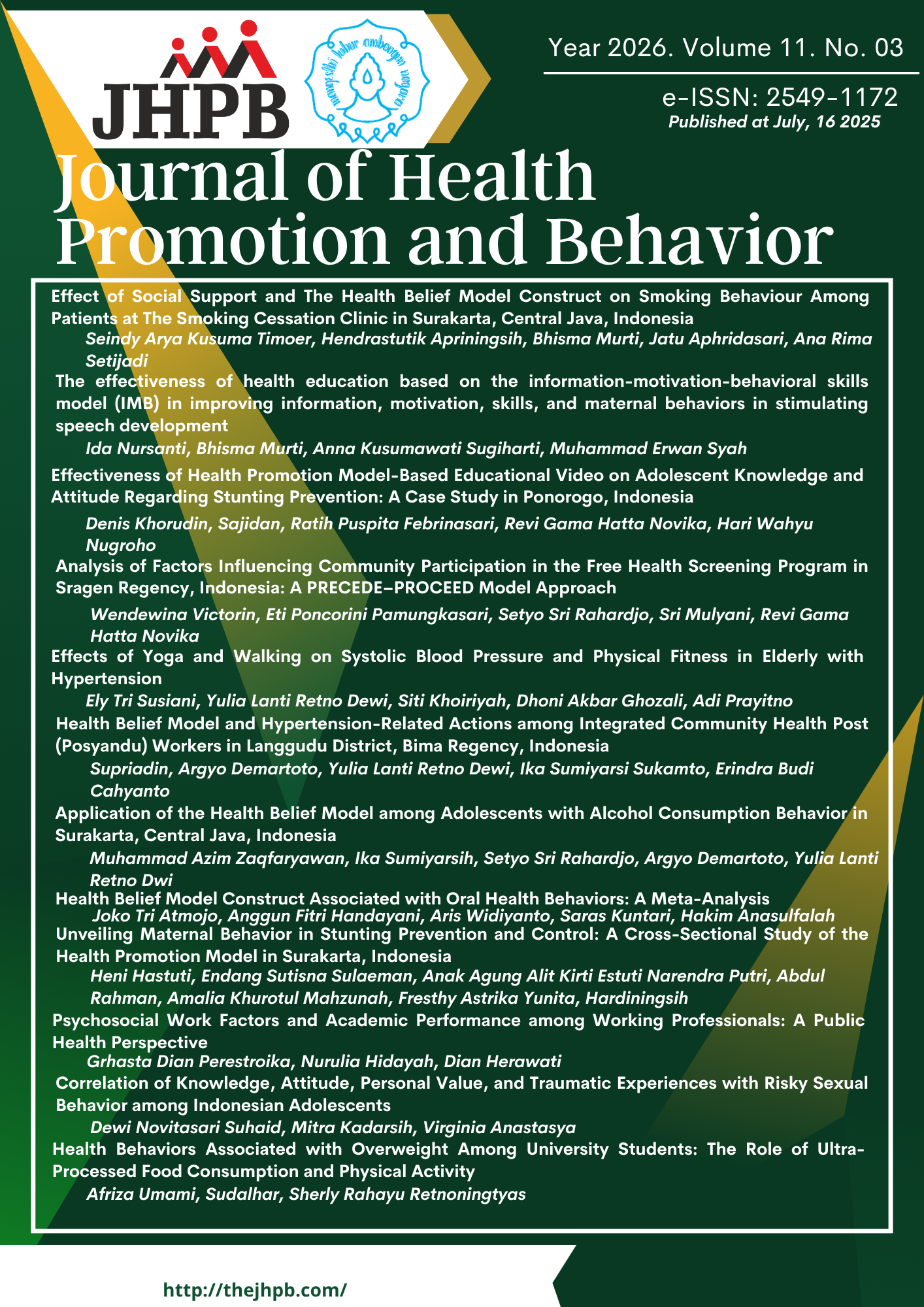
How to Cite
References
Anggraini TNYA, Utami NW, Pusvitasari P. (2024). Health Believe Model of Growth Monitoring to Prevent Child Stunting by Mothers in the Pregnancy Classroom. Proceedings of the 2nd Lawang Sewu International Symposium on Health Sciences: Midwifery (LSISHS-M 2023). https://doi.org/10.2991/978-94-6463-461-7_20.
Anjomshoa H, Mirzaee M, Iranpour A. (2018). The application of social cognitive theory on mothers’ feeding practices for children aged 6 to 24 months old in Iran. Int J Pediatr. 6(7):83–97. https://doi.org/10.22038/ijp.2018.28326.2459.
Arini D, Faridah, Nuraini I. (2022). The relationship of mother’s self-efficacy with cognitive development and stunting among toddlers in the area of Kalirungkut Puskesmas, Surabaya City. Malays J Nurs. 14(02):55–59. https://doi.org/10.31674/mjn.2022.v14i02.010.
Arini D, Nursalam N, Mahmudah M, Faradilah I. (2020). The incidence of stunting, the frequency/duration of diarrhea, and acute respiratory infection in toddlers. J Public Health Res. 9(2). https://doi.org/10.4081/jphr.2020.1816.
de Onis M, Branca F. (2016). Childhood stunting: a global perspective. Matern Child Nutr. 12(1):12–26. https://doi.org/10.1111/mcn.12231.
Diana HAH, Yusandra E. (2022). Enhancing maternal behavior towards prevention of stunting among children below five years old in the district of Tebing Tinggi, Indonesia. Malays J Nurs. 14(02):67–74. https://doi.org/10.31674/mjn.2022.v14i02.012.
Fajar NA, Zulkarnain M, Taqwa R, Sulaningsi K, Ananingsih ES, Rachmayanti RD, Sin SC. (2023). Family roles and support in preventing stunting: A systematic review. Jurnal Promosi Kesehatan Indonesia. 19(1):50–57. https://doi.org/10.14710/jpki.19.1.50-57.
Gaines A, Turner LW. (2009). Improving fruit and vegetable intake among children. Calif J Health Promot. 7(1):52–66. https://doi.org/10.32398/cjhp.v7i1.1320.
Gerakan Kesehatan Ibu dan Anak (GKIA). (2024). Open Statement from the Indonesian Maternal and Child Health and Nutrition Movement (GKIA) on the Role of Milk in “Stunting Prevention”.
Governor of Central Java. (2019). Acceleration of Stunting Prevention in Central Java Province.
Hall C, Bennett C, Crookston B, Dearden K, Hasan M, Linehan M, Syafiq A. (2018). Maternal knowledge of stunting in rural Indonesia. Int J Child Health Nutr. 7(4):139–145. https://doi.org/10.6000/19294247.2018.07.04.2.
Irfa ILN, Maimunah S, Badi'ah A. (2024). The effect of peer support group method stunting prevention education on mothers’ knowledge and children’s nutritional status in Benculuk Village, Cluring District, Banyuwangi. Prof Health J. 6(1):246–258. https://doi.org/10.54832/phj.v6i1.748.
Mahmudiono T, Segalita C, Rosenkranz RR. (2019). Socio-ecological model of correlates of double burden of malnutrition in developing countries: A narrative review. Int J Environ Res Public Health. 16(19):3730. https://doi.org/10.3390/ijerph16193730.
Martha E, Nadira NA, Sudiarti T, Mayangsari AP, Enjaini EF, Ryanthi TP, Bangun DE. (2020). The empowerment of cadres and traditional birth attendants in the early detection and prevention of stunting in North Bogor District, Bogor, West Java. Indones J Public Health. 15(2):153–161. https://doi.org/10.20473/ijph.v15i2.2020.153-161.
Mediani HS, Hendrawati S, Pahria T, Mediawati AS, Suryani M. (2022). Factors affecting the knowledge and motivation of health cadres in stunting prevention among children in Indonesia. J Multidiscip Healthc. 15(1):1069–1082. https://doi.org/10.2147/JMDH.S356736.
Mirzakhani K, Ebadi A, Faridhosseini F, Khadivzadeh T. (2023). Pregnant women’s experiences of well-being in high-risk pregnancy: A qualitative study. J Educ Health Promot. 12(1). https://doi.org/10.4103/jehp.jehp_1542_21.
Muche A, Dewau R. (2021). Severe stunting and its associated factors among children aged 6–59 months in Ethiopia; multilevel ordinal logistic regression model. Ital J Pediatr. 47(1):161. https://doi.org/10.1186/s13052-021-01110-8.
Mustikawati IS, Putri SSELM, Mahadewi EP, Muniroh M, Nurmalasari M, Sangadji NW. (2024). The effectiveness of stunting prevention promotion to improve mothers’ knowledge. NUSRA. 5(1):400–406. https://doi.org/10.55681/nusra.v5i1.2263.
Nenobais DI, Katmini K. (2021). Application of Health Belief Model theory on prevention of stunting in toddlers through nutritional behavior. J Qual Public Health. 5(1):27–34. https://doi.org/10.30994/jqph.v5i1.244.
Noor RI, Muniroh L. (2023). Hubungan antara persepsi ibu dengan kejadian stunting berdasarkan teori Health Belief Model. Kesehatan Tambusai. 4(3):9–19. https://doi.org/10.31004/jkt.v4i3.18285.
Noviana U, Ekawati H, Mufarika, Hasinuddin M, Haris M. (2023). Mother’s behavior attachment model in care for stunting prevention in Bangkalan district. J Nurs Pract. 7(1):57–66. https://doi.org/10.30994/jnp.v7i1.415.
Pandani NWP. (2021). The role of social support in mother’s interest in preventing stunting. Community Med Educ J. 1(1):44–52. https://doi.org/10.37275/cmej.v1i1.103.
Presidential Regulation of the Republic of Indonesia Number 72 of 2021 Concerning the Acceleration of Reducing Stunting (2021).
Republic of Indonesia Ministry of People’s Welfare. (2013). Program Planning Guidelines for the National Movement to Accelerate Nutrition Improvement in the Context of the First Thousand Days of Life (1000 HPH Movement).
Shorey S, Lopez V. (2021). Self-Efficacy in a Nursing Context. 2021 Mar 12. In: Haugan G, Eriksson M, editors. Health Promotion in Health Care – Vital Theories and Research. Cham (CH): Springer. Chapter 12. https://doi.org/10.1007/978-3-030-63135-2_12.
Soviyati E, Sulaeman ES, Sugihardjo Ir, Wiboworini B. (2023). Effect of applying the health promotion model in stunting prevention and behavior control in Indonesia. J Educ Health Promot. 12(1). https://doi.org/10.4103/jehp.jehp_276_23.
Surakarta City Health Office. (2023). Surakarta City Health Profile 2022.
Syahputra D, Yustina I, Nurmaini N, Rochadi K, Zuska F. (2023). The correlation of mother’s knowledge and mother’s behavior in stunting prevention efforts in Tuntungan Village, Deli Serdang Regency. Int J Midwifery Res. 3(1):31–39. https://doi.org/10.47710/ijmr.v3i1.48.
United Nations Children’s Fund. (2021). Levels and trends in child malnutrition UNICEF/WHO/World Bank Group Joint Child Malnutrition Estimates Key findings of the 2021 edition.
Wardani N, Harumi AM, Kasiati K, Windi YK, Husni E, Cahyani TIP. (2022). Mothers’ perceived susceptibility and severity of maternal behavior in stunting prevention. Maced J Med Sci. 10(E):1369–1373. https://doi.org/10.3889/oamjms.2022.9888.
WHO. (2009). WHO child growth standards and the identification of severe acute malnutrition in infants and children.
WHO. (2014). Global nutrition targets 2025: stunting policy brief. Retrieved from https://www.who.int/publications/i/item/WHO-NMH-NHD-14.3.
Wilianarti PF, Wulandari Y, Ghufron M, Rahman FS. (2022). Stunting prevention in coastal families with a health-promoting family approach. Open Maced J Med Sci. 10(G):290–296. https://doi.org/10.3889/oamjms.2022.8456.
Wulandari RD, Laksono AD, Kusrini I, Tahangnacca M. (2022). The targets for stunting prevention policies in Papua, Indonesia: What mothers’ characteristics matter? Nutr. 14(3):549. https://doi.org/10.3390/nu14030549.