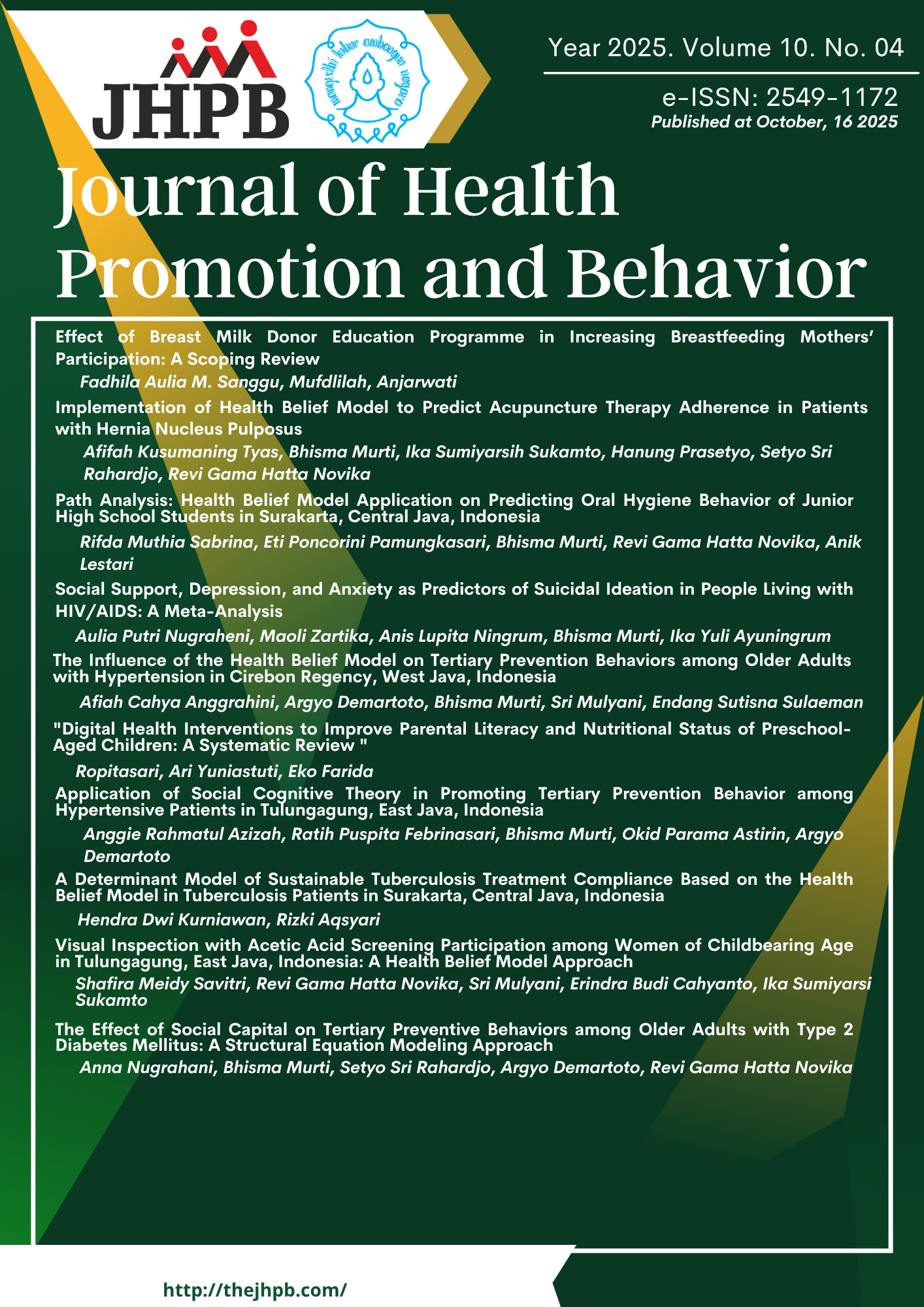
The Influence of the Health Belief Model on Tertiary Prevention Behaviors among Older Adults with Hypertension in Cirebon Regency, West Java, Indonesia
DOI:
https://doi.org/10.26911/Abstract
Background: Hypertension is one of the most prevalent non-communicable diseases among older adults and contributes substantially to the development of complications and a decline in quality of life. Tertiary prevention is therefore crucial to slow disease progression. This study aimed to analyze the influence of Health Belief Model (HBM) constructs on tertiary prevention behaviors among older adults with hypertension.
Subjects and Method: This quantitative study employed a cross-sectional design. The respondents consisted of 200 older adults with hypertension in Cirebon Regency, selected using a multistage random sampling technique. Data were collected using a standardized questionnaire that had been tested for validity and reliability. Multivariate data analysis was conducted using path analysis to identify both direct and indirect effects among variables.
Results: Perceived benefits were found to have a direct effect on tertiary prevention behaviors among older adults with hypertension (b= 0.17; 95% CI= 0.13 to 0.30; p= 0.023), as was self-efficacy (b= 0.14; 95% CI= 0.01 to 0.27; p= 0.036). In contrast, perceived susceptibility, perceived severity, perceived barriers, and cues to action influenced tertiary prevention behaviors indirectly. The resulting path model demonstrated a good level of model fit.
Conclusion: Health Belief Model constructs can be utilized as a behavioral approach to enhance adherence to tertiary prevention behaviors among older adults with hypertension. HBM-based interventions that consider individual perceptions and social support are recommended as effective strategies in geriatric health care services.
How to Cite
References
Arindari DR, Suswitha D (2020). Health Belief Model factors to medication adherence among hypertensive patients in Punti Kayu Public Health Center Palembang, Indonesia. J Keperawatan. 11(1):22-7. doi:10.22219/jk.v11i1.10483.
Azadi NA, Ziapour A, Lebni JY, Irandoost SF, Abbas A, Chaboksavar F (2021). The effect of education based on health belief model on promoting preventive behaviors of hypertensive disease in staff of the Iran University of Medical Sciences. Arch Public Health. 79(1):1-8. doi:10.1186/s13690-021-00594-4.
Center for Data and Information, Ministry of Health of the Republic of Indonesia. (2022). Empowered Older Adults for a Prosperous Nation (in Indonesia).
Dinas Kesehatan Kabupaten Cirebon. (2023). Profil Kesehatan Kabupaten Cirebon. Kabupaten Cirebon.
Ekasari MF, Suryati ES, Badriah S, Narendra SR, Amini FI. (2021). Kenali penyebab, tanda gejala dan penangannya. Hipertensi. p.28.
Findlow WJ, Seymour RB, Huber LRB. (2012). The association between self-efficacy and hypertension self-care activities among African American adults. J Community Health. 37(1):15-24. doi:10.1007/s10900-011-9410-6.
Hajri Z. (2021). Lifestyle characteristics of individuals with hypertension (in Indonesia). Jurnal Ilmiah PANNMED (Pharmacist, Analyst, Nurse, Nutrition, Midwivery, Environment, Dentist). 16(2):326-30. https://doi.org/10.36911/pannmed.v16i2.1123.
Haryani N, Subiyanto A, Suryani N. (2016). Effect of health education on health behavior in patients with hypertension. J Health Promot Behav. 1(1):9-18. doi:10.26911/thejhpb.2016.01.01.02.
Hermanto H, Katmini K. (2021). Application of HBM theory (Health Belief Model) to preventing behavior of hypertension complications in Public Health Center Raas, Sumenep Regency. J Qual Public Health. 5(1):149-59. doi:10.30994/jqph.v5i1.263.
Intarti WD, Khoriah SN. (2018). Factors influencing the utilization of integrated health service posts for older adults (in Indonesia). J Health Stud. 2(1):110-22. doi:10.31101/jhes.439.
Joho AA. (2021). Using the Health Belief Model to explain the patient’s compliance to anti-hypertensive treatment in three district hospitals - Dar Es Salaam, Tanzania: a cross-section study. East Afr Health Res J. 5(1):50-8. doi:10.24248/eahrj.v5i1.651.
Khorsandi M, Fekrizadeh Z, Roozbahani N. (2017). Investigation of the effect of education based on the health belief model on the adoption of hypertension-controlling behaviors in the elderly. Clin Interv Aging. 12:233-40. doi:10.2147/CIA.S117142.
Mancia G, Kreutz R, Brunström M, Burnier M, Grassi G, Januszewicz A, Muiesan ML, et al. (2023). 2023 ESH Guidelines for the management of arterial hypertension. J Hypertens. doi:10.1097/HJH.0000000000003480.
Maulana N. (2022). Prevention and Management of Hypertension in Older Adults (in Indonesia). J Peduli Masyarakat. 4(1):163-8. Available at: http://jurnal.globalhealthsciencegroup.com/index.php/JPM.
Ministry of Health of the Republic of Indonesia. (2018). Basic Health Research 2018: National Report of Basic Health Research 2018 (in Indonesia). 44(8):181-222.
Mohi NY, Irwan I, Ahmad ZF. (2023). Factors associated with the occurrence of hypertension among older adults in the service area of Wonggarasi I Primary Health Center (in Indonesia). J Health Sci Gorontalo J Health Sci Community. 8(1):1-13. doi:10.35971/gojhes.v8i1.21060.
National Development Planning Agency of the Republic of Indonesia. (2023). Roadmap for the Sustainable Development Goals 2023–2030 (in Indonesia). Ministry of National Development Planning.
Nematzad P, Pourghane P, Besharati F, Chaboki BG. (2022). Effects of health belief model in promoting self-care behaviors among hypertensive older adults. J Educ Health Promot. (June):1-7. doi:10.4103/jehp.jehp.
Pan Q, Zhang C, Yao L, Mai C, Zhang J, Zhang Z, Hu J. (2023). Factors influencing medication adherence in elderly patients with hypertension: a single center study in Western China. Patient Prefer Adherence. 17:1679-88. doi:10.2147/PPA.S418246.
Puspita RC, Tamtomo D, Indarto D. (2017). Health Belief Model for the analysis of factors affecting hypertension preventive behavior among adolescents in Surakarta. J Health Promot Behav. 2(2):183-96. doi:10.26911/thejhpb.2017.02.02.08.
Ricinta PA, Fahdhienie F, Ariscasari P. (2024). Analysis of hypertension prevention behavior based on Health Belief Model at Pulau Nasi, Pulo Aceh. Media Publikasi Promosi Kesehatan Indones. 7(8):2242-9. doi:10.56338/mppki.v7i8.5952.
Sartik S, Tjekyan RS, Zulkarnain M. (2017). Risk factors and the incidence of hypertension in Palembang. J Ilmu Kesehat Masyarakat. 8(3):180-91. doi:10.26553/jikm.2017.8.3.180-191.
Setiyaningsih R, Tamtomo D, Suryani N. (2016). Health Belief Model: determinants of hypertension prevention behavior in adults at Community Health Center, Sukoharjo, Central Java. J Health Promot Behav. 1(3):160-70. doi:10.26911/thejhpb.2016.01.03.03.
Solhi M, Abbasi Z, Rasouli M, Naderi N. (2023). Comparison of perceived self-efficacy, benefits, and barriers of hypertension control between male and female patients referred to Rajaie Cardiovascular Medical and Research Center in Tehran. J Tehran Univ Heart Cent. 18(1):52-61. doi:10.18502/jthc.v18i1.12582.
Tsadik DG, Berhane Y, Worku A. (2020). Adherence to antihypertensive treatment and associated factors in central Ethiopia. Int J Hypertens. 2020:10-3. doi:10.1155/2020/9540810.
United Nations Department of Economic and Social Affairs, Population Division. (2020). World population ageing 2020 highlights: Ten key messages. United Nations.
World Health Organization. (2019). World health statistics. WHO. Switzerland.
Yue Z, Li C, Weilin Q. (2015). Application of the health belief model to improve the understanding of antihypertensive medication adherence among Chinese patients. Patient Educ Couns. 98(5):669-73. doi:10.1016/j.pec.2015.02.007.